
Is It Safe to Order Mangoes Online in India? A Farmer's Honest Checklist

Abhilash Kasliwal

Table of Contents
- The fear is earned, so start there
- Check 1 — does the seller name the farm, the family, the village?
- Check 2 — do they tell you the fruit arrives firm?
- Check 3 — weight honesty
- Check 4 — what a real damage policy sounds like
- Check 5 — season honesty
- What ordering from us actually looks like, awkward parts included
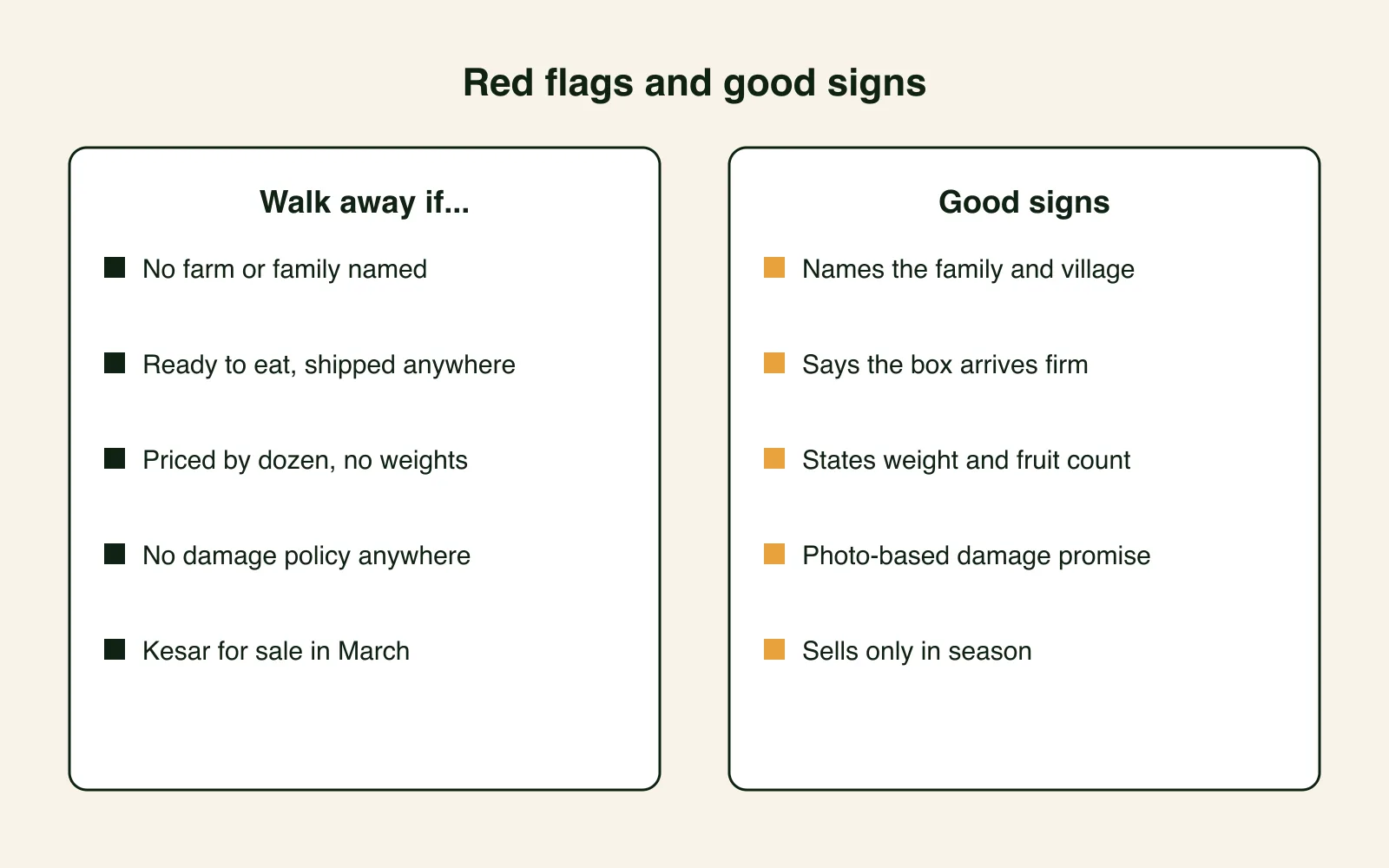
Yes — ordering mangoes online in India is safe if you check five things before you pay: whether the seller names the farm and family behind the fruit, whether they admit the box will arrive firm, whether they sell by stated weight and count rather than by the dozen, whether their damage policy commits to a photo-based replacement or refund, and whether they sell only in season. Most online mango disappointments — rotten boxes, underweight deliveries, sellers who go silent after payment — trace back to a seller who fails at least one of these checks.
The fear is earned, so start there
Search any where-should-I-buy-mangoes-online thread and the same stories repeat. A long-running Quora answer on the best places to buy notes that what gets delivered rarely matches what was promised. Review sites carry the harder cases: boxes that arrived rotten, fruit well under the promised weight, and complaint emails that never got a reply.
We sell mangoes online, so there is an obvious awkwardness in us writing this. But the anger in those reviews is earned. Mangoes are perishable, bought sight-unseen, at premium prices, in a short rush of seasonal demand — near-perfect conditions for careless or dishonest selling. The checklist below is how you filter, and it applies to us as much as to anyone.
Check 1 — does the seller name the farm, the family, the village?
Online mango sellers split into growers selling their own fruit and aggregators buying at a mandi and relabelling it "farm fresh". An aggregator is not automatically dishonest, but they cannot answer the questions that matter — which orchard, picked when, ripened how — because they do not know. A grower who names the family and the region has attached a reputation to every box, which changes behaviour when something goes wrong. A site full of beautiful mango photography with no named human behind it has already failed one check.
Check 2 — do they tell you the fruit arrives firm?
This is the least known check and, in our experience, the most reliable. Mangoes ripen after picking, so honest farm shipping means harvesting fruit mature but firm, letting it travel, and letting it finish ripening on your counter over two to four days. An honest mango website therefore contains a slightly awkward sentence somewhere: your mangoes will not be ready to eat on arrival.
A seller promising ripe-on-delivery across India is describing fruit that was picked long ago, treated to colour up on schedule, or about to arrive bruised. When a promise sounds better than plant biology allows, believe the biology. Our ripening guide shows what those few counter days look like, and our carbide guide explains what "treated" means and how to catch it after delivery.
Check 3 — weight honesty
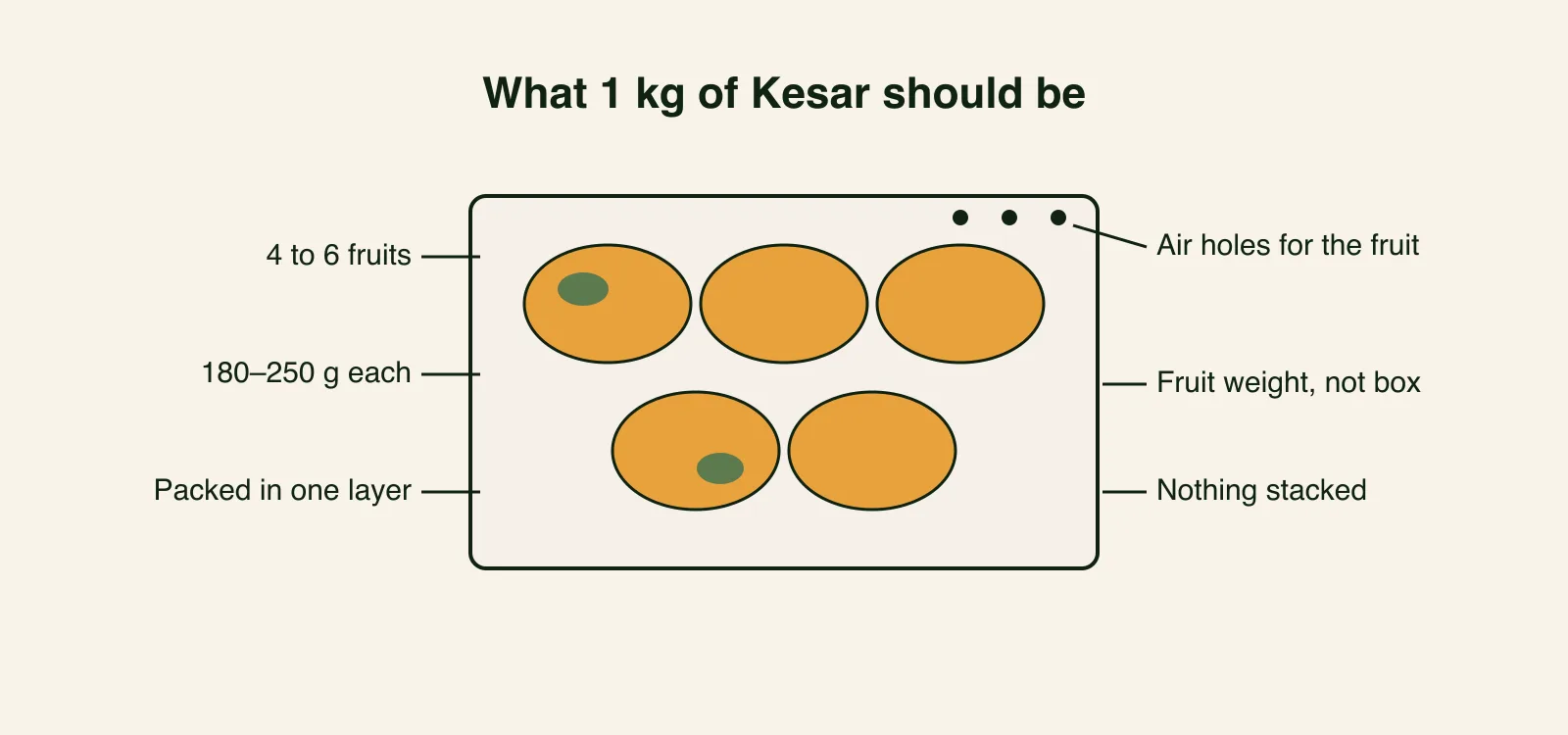
Know what you should receive before you compare anyone. A Kesar mango weighs 180 to 250 grams, so 1 kg is four to six fruits, and a 5 kg box holds roughly 20 to 30. An honest listing states the net fruit weight and an expected count range.
Dozen-pricing is how fruit size hides. "12 premium mangoes" tells you nothing you can compare — at Kesar weights it could mean 2.2 kg of fruit or 3 kg, a 35 percent difference at the same price. The complaints about underweight boxes almost always start with a listing that never stated a weight to hold the seller to.
Check 4 — what a real damage policy sounds like
Couriers damage some boxes; that is a fact of moving perishable fruit, so the policy is what separates sellers. A real one reads like a procedure: send a photo the day of delivery, a person reviews it, and you get a replacement or a refund. A red flag reads like a wall: "no returns on perishable items" as the entire policy, which quietly converts every transit accident into your loss. Find the damage policy before you order. If you cannot find one in two minutes of looking, that absence is the answer.
Check 5 — season honesty
Kesar exists from mid-April to late June — our month-by-month season guide covers the window in detail. Anyone selling "fresh Kesar" in March or in August is selling mislabelled fruit or cold-stored stock, and the same logic applies to Alphonso outside roughly March to June. A seller whose store closes for nine months of the year is demonstrating something: seasonality is a credential, and a mango website that never stops selling has explained itself.
What ordering from us actually looks like, awkward parts included
Since the checklist applies to us too, here is our answer to it, step by step.
You order 1 to 10 kg of Kesar at ₹300 per kg. The 1 kg trial box exists so you can test us cheaply; the 5 kg box carries 25 percent off.
Your order waits for a harvest day. We pick when a block of trees reaches maturity, so weather can move dispatch by a few days — we tell you when it does.
Our family grades and packs your box by hand, in a single layer, with the count and weight the listing promised.
The courier carries it across India. You can ask where your box is at any point over personal messages, and a person from the family answers.
The box arrives firm, on purpose, and ripens on your counter in two to four days.
If anything arrives damaged, you send a photo the day of delivery and we make it right — a replacement or a refund, decided in a conversation, quickly.
The parts a slicker operation would hide are in there: we are slower than a quick-commerce app, the fruit needs a few days of patience after arrival, and for nine months of the year we have nothing to sell you. Those are the costs of the thing you are actually trying to buy.
Run every seller through the five checks — including us. Any seller worth your money passes all five.
FAQ
Questions readers often ask
Keep Reading
More stories from the orchard

Kesar vs Alphonso — Which Mango Should You Buy?
Both are elite mangoes. Alphonso brings buttery dessert richness at ₹1,000-plus per kg online; Kesar brings saffron aroma and a sweet-tang balance at a third of the price. Here is how to choose.
Abhilash Kasliwal
6 min read

How to Tell if a Mango Was Ripened with Carbide — 5 Home Tests
Five checks — water, skin, stem, cut and taste — that catch most carbide-ripened mangoes, what each one can and cannot prove, and why the difference exists at all.
Abhilash Kasliwal
7 min read

How to Ripen Kesar Mangoes at Home — A Day-by-Day Guide
Firm Kesar mangoes ripen on the counter in 2–4 days. When the rice jar helps, when the fridge ruins fruit, and how to tell a Kesar is ready by smell, give and colour.
Abhilash Kasliwal
6 min read