
Why Do Indians Soak Mangoes in Water Before Eating? Grandma vs Science

Abhilash Kasliwal

Soaking mangoes in water for 20 to 30 minutes before eating does two useful things: it washes off the sap and residue that collect at the stem end and on the skin, and it cools fruit that has been sitting in summer heat. The sap is the strong reason. Mango belongs to the same plant family as poison ivy, and the fluid that seeps from a freshly picked fruit's stem carries related irritants that can sting lips and skin. The third explanation families give, that soaking draws the "heat" out of the fruit, has much thinner evidence, so we will treat it separately.
The ritual, and the three reasons families give
In most Indian households the routine is automatic: mangoes come home, mangoes go into a bucket or a basin of water, and only after a proper soak does anyone get to eat one. Ask why and you will usually hear one of three answers. The mangoes are garam, heaty, and the water calms them down. The mangoes have sap or chemicals on them that must come off. Or simply: because grandma said so, and grandma was right about most things.
Grandma was right about this one too, though not always for the reason she gave. Two of the three explanations survive scrutiny.
Why do some people soak ripe mangoes in cold water before eating?
Start with the explanation that holds up best. Mango is a member of the Anacardiaceae family, the same family as poison ivy and cashew, and its sap contains urushiol-related compounds. When a mango is picked, sap spurts from the broken stem and runs down the fruit, then dries into a faint varnish around the stem cap and on the skin. In sensitive people, contact with this dried sap causes an itchy rash around the lips and chin, common enough to have its own name: mango mouth.
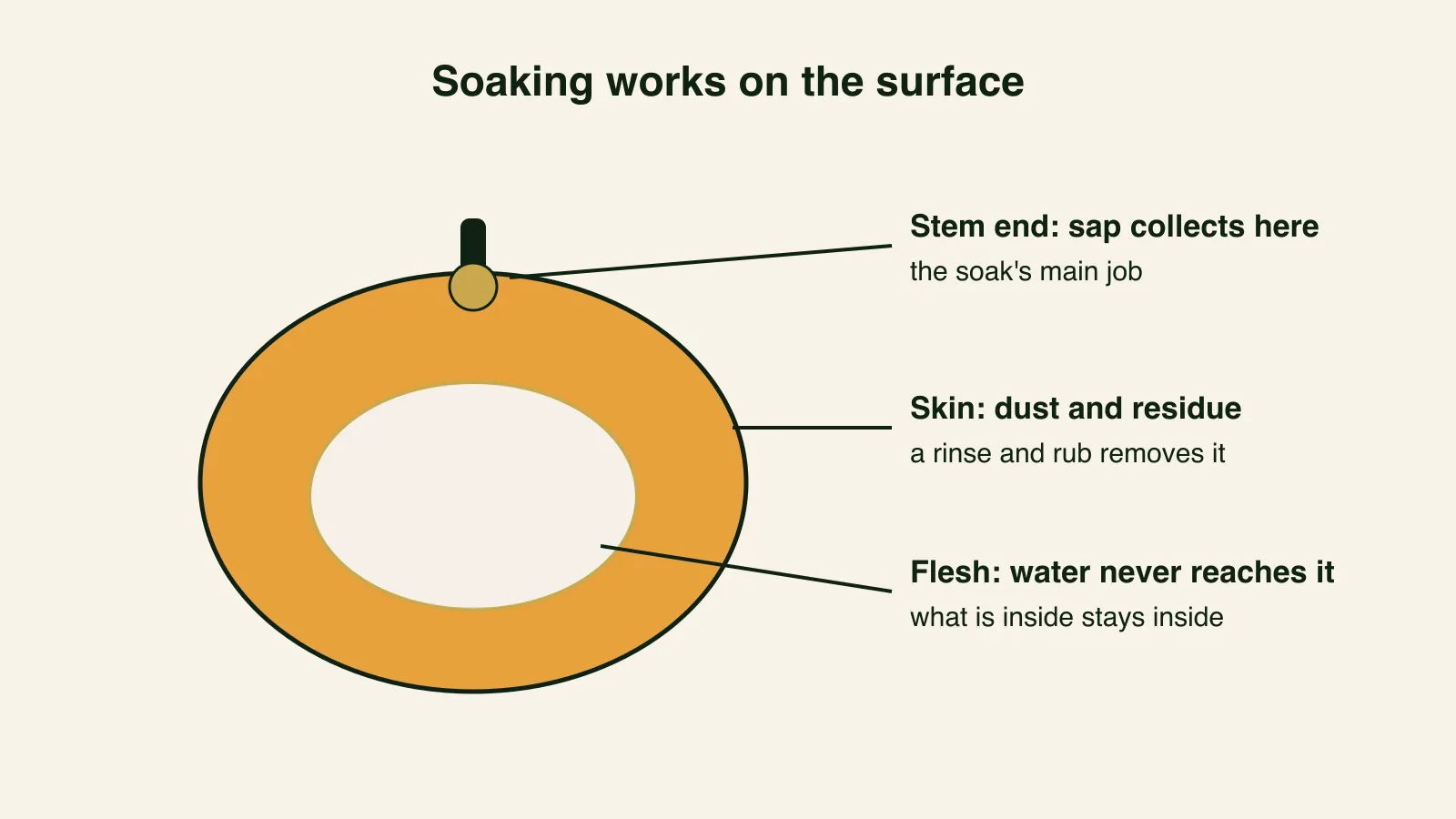
Careful orchards limit the problem at harvest by cutting the stalk long and letting fruit drain stem-down, but no handling removes sap entirely, and market fruit picks up dust and handling residue on top of it. A rinse followed by a soak softens the dried sap so a rub under water takes it off, along with whatever else the skin collected between tree and kitchen. Note where all of this sits: on the surface. Which is also the key to judging every other claim about soaking.
Is it just a myth that mangoes increase body heat?
This is where honesty requires splitting the traditions apart. Ayurveda classifies foods by their effect on the body, and mango sits in the warming category, which is where the garam belief comes from. Modern nutrition science has no measurement that maps onto this idea, and no study we could point to shows that soaking a mango changes anything inside the fruit.
The mechanism argument is the simplest one: soaking is a surface operation. Water sitting against the peel for half an hour cannot pull compounds out of the flesh, because the peel exists precisely to keep the inside in and the outside out. What soaking genuinely does is lower the fruit's temperature, and a fruit that has spent a May afternoon in a Marathwada kitchen can be close to 40 degrees. Cool fruit on a hot day is a real, physical comfort, and we suspect much of the "the soak calms the mango" experience is exactly this.
So our verdict, held respectfully: the cooling is real, the sap-washing is real, and "drawing the heat out" has no mechanism anyone can point to.
The same logic applies to a newer claim, that soaking leaches out phytic acid, a compound that can bind minerals in the gut. Phytic acid lives mainly in grains, legumes, nuts and seeds; ripe mango flesh contains very little, and whatever it does contain sits behind the peel where soak water cannot reach it. The evidence here is thin, and we would rather say so than repeat the claim because it sounds scientific.
Does consuming mangoes increase pimples?
The folk chain runs mango, heat, pimples. The evidence for it is weak, but two real mechanisms sit nearby. First, sap contact: the same urushiol-family irritants that cause mango mouth can produce bumps around the lips that look like a breakout and are actually contact rash. Soaking and washing the fruit, and cutting it rather than biting into an unwashed one, deals with this. Second, sugar: diets heavy in fast-absorbed sugar are one suspected contributor to acne, and a mango binge in peak season is a lot of sugar. The fix is portions rather than abstinence; we have written about mango sugar in detail in can diabetics eat Kesar mangoes.

Do organic, carbide-free mangoes still need soaking?
Yes, and this is worth being precise about, because it is the question where a farm selling organic fruit could be tempted to flatter itself. Sap comes from the tree, and orchard dust comes from the air, so our fruit carries both, same as anyone's. Soak it.
What changes with fruit like ours is what you are washing off. With market fruit of unknown origin, the soak is also doing duty against pesticide film on the peel and residue from artificial ripening agents. With certified organic, carbide-free fruit, those two worries are off the list before the fruit reaches your bucket, and the soak is back to its original honest jobs: sap, dust, and temperature. The ritual stays; the anxiety behind it shrinks.
The right way to do it
Rinse each fruit under running water and rub the stem end with your thumb, since that is where the dried sap sits. Then soak for 20 to 30 minutes in plain water. There is nothing more to extract after that, so hours-long soaking earns you nothing, and overnight soaking softens the skin and shortens the fruit's life. After the soak, chill the mangoes in the fridge if you like them cold, then cut and eat. If a box has just arrived and the fruit is still firm, soak on the day you eat, and let the rest ripen dry; a week's worth of ripening and eating plans is laid out in what to do with 5 kg of Kesar mangoes.
FAQ
Questions readers often ask
Keep Reading
More stories from the orchard

Kesar vs Alphonso — Which Mango Should You Buy?
Both are elite mangoes. Alphonso brings buttery dessert richness at ₹1,000-plus per kg online; Kesar brings saffron aroma and a sweet-tang balance at a third of the price. Here is how to choose.
Abhilash Kasliwal
6 min read

How to Tell if a Mango Was Ripened with Carbide — 5 Home Tests
Five checks — water, skin, stem, cut and taste — that catch most carbide-ripened mangoes, what each one can and cannot prove, and why the difference exists at all.
Abhilash Kasliwal
7 min read

How to Ripen Kesar Mangoes at Home — A Day-by-Day Guide
Firm Kesar mangoes ripen on the counter in 2–4 days. When the rice jar helps, when the fridge ruins fruit, and how to tell a Kesar is ready by smell, give and colour.
Abhilash Kasliwal
6 min read